-
Copyright (©) Citizenkat Sphynx, 2008-2014
No parts of this website may be reproduced without permission

Feline Raw Diet
**This is the story of our experience, combined with extensive research for our search for the best possible food for our beloved pets.
IMPORTANT!!!! Raw diets must be specifically designed to contain certain proportions. The good news is that the recipe below is balanced as it is. You must do this correctly or your cat will not be receiving proper nutrition. You have to be cognizant of all the minerals and nutrients needed to maintain a healthy cat.... especially taurine. While a balanced raw diet is the best thing you can feed your cat, an UNbalanced raw diet is the worst thing you can feed your cat.
Table of Contents:
I fed my cats a commercial diet including kibble and canned food for many years.
The kitties seemed to do great. So I thought. I researched feline nutrition
constantly, tried the newest foods, the most expensive, and sincerely believed I
was feeding them the best food.
Then, I changed for the better thanks to Carole Bohanan-Uhler, a friend of mine.
Carole passionately told me about this diet called the “Raw Diet”. At first I
questioned it and thought, “How much better could it be?”. I did not start it
right away as I was skeptical. However, I saw Carole's Sphynx for over 5 years
at the shows and at her home. They
were always in good condition, beautiful skin, clean ears, good weight, firm,
non-smelly stools and were good producers with large healthy litters.
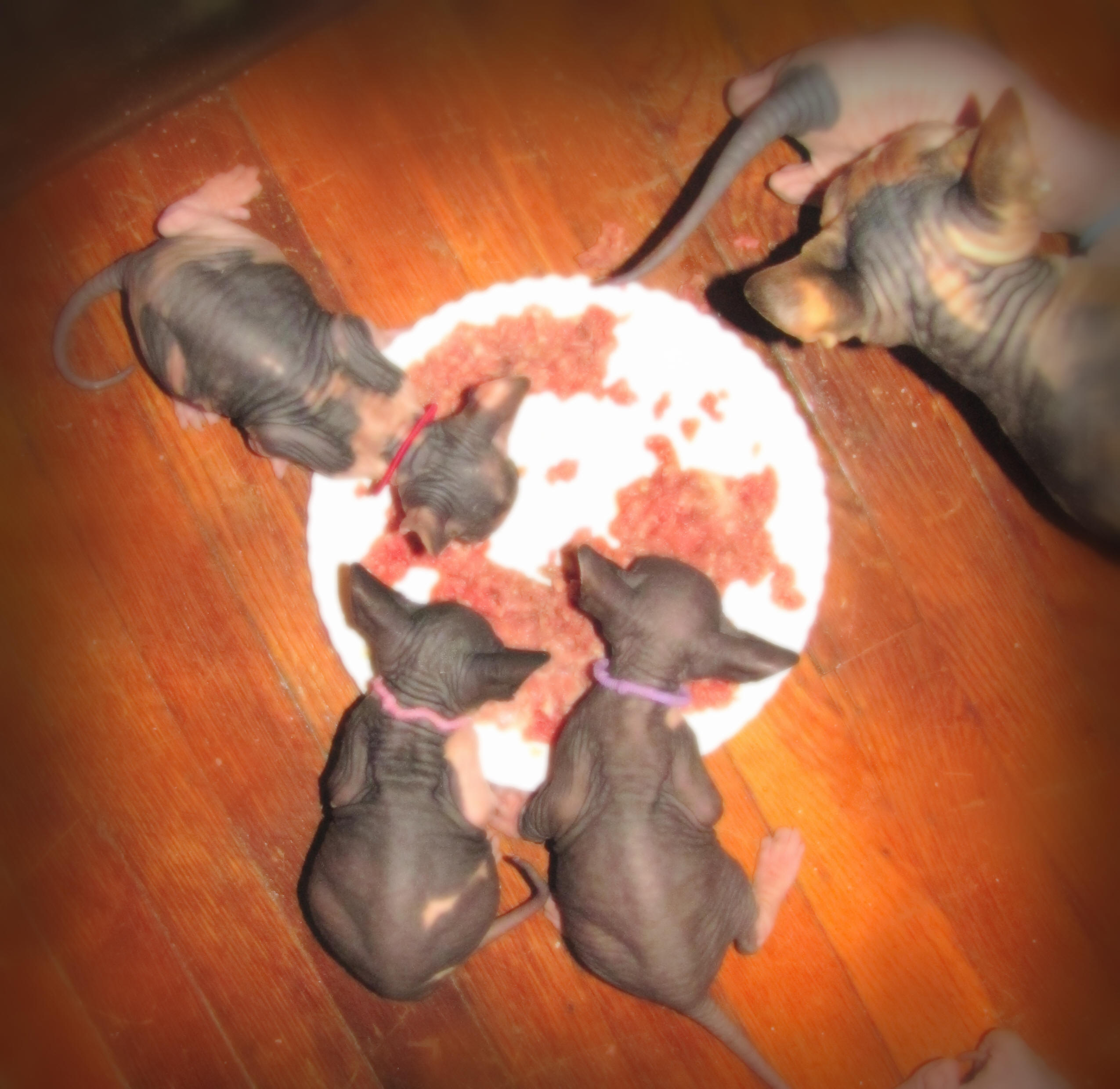
Kittens pictured below are 4 weeks
old eating homemade raw food!
In 2008, there were a multitude of pet food recalls. It was scary that the pet
food market was not regulated and had poisonous, harmful ingredients.
I had no idea what was really going into
my cats' food.
I thought logically about what they would eat naturally. Mice and birds!
Felines are obligate carnivores and they need to eat meat. Unlike dogs or
humans, they do not need any vegetables, nor do they possess the physiology to
break down the phytates in plants in order to derive nutrients from them. Not
only that, the lack of hydration in kibble was a huge concern. Cats do not have
a natural thirst drive like dogs or humans. They are from the desert and
therefore designed to derive most of their moisture from their prey. Yes, they
will drink water, but that does not mean they are properly hydrated.
I went through the local and chain pet stores, examined the ingredients and
realized commercial diets are filled with inappropriate ingredients such as
gluten, corn, grains, vegetables and other unnecessary fillers. Some of those
ingredients are actually allergens to most felines - especially soy, corn and
gluten.
I looked more into soy as it was an ingredient in one of the foods I was feeding. In fact it is in about 50% of dry cat foods. I was astonished to learn how something I had thought was healthy was the complete opposite. It is an ingredient that can be damaging to felines. Potential issues include infertility, hyperthyroidism, and seizures.
This excerpt is from Dr. Becker from
www.HealthyPetsMercola.com:
…in 1985, 29 cheetahs in American zoos died, many from liver disease. Only 18
were born, and 7 of those died before reaching adulthood.
As few as 10 percent of adult female cheetahs living in captivity in North
America produced live cubs in the mid-1980s. Yet in other countries, 60 to 70
percent was the norm. The difference? Cheetahs living and breeding successfully
in other parts of the world were fed whole animal carcasses. North American
cheetahs were fed a commercial feline diet of horsemeat and soy.
Researchers in Ohio studied the food the North American cheetahs were eating.
They found the soy portion of the diet contained plant estrogens similar to the
hormones found in female mammals.
Four cheetahs in a U.S. zoo were switched to a diet of chicken meat and no soy.
Liver function improved, however,
whether the cats would ever be able to breed successfully remained a question
mark.
The researchers theorized the cheetahs were probably extra-sensitive to the
effects of plant estrogens due to inbreeding (the result of a previous
population crisis). However, the amount of soy in their diets was relatively
small, leading the scientists to conclude all felines probably have difficulty
ridding their bodies of excess estrogens.
Cornell University’s newsletter
CatWatch came out
with this in 2008:
“What’s the one food you should
feed your cat for optimal health? Wet food. Feeding your cat wet
food, and not letting her eat from a dry food dispenser, could
be the single greatest thing you do for her health and
longevity. (New research shows wet food helps prevent diabetes,
heart disease — even feline arthritis!)”
One of my biggest concerns about the raw diet was bacteria.
After all, it was the main argument by the CDC, veterinarians and other experts.
I discovered that the felines are designed with a highly acidic short
digestive tract that makes it extremely hard for bacteria to survive. The
digestive time of felines is much faster than that of our own, or other
omnivores. This, along with knowing Carole’s cats were so healthy, eased my
mind.
Once I figured out the best places to go to procure the meat, and I had the
grinding down to a system, making raw became very easy. It takes about 2
hours of time including clean-up time. A lot of people state they do not have
enough time. It only needs to be done once a month for most people. I have to do
it twice a month and I have 4 hours a month to make my cats’ raw food.
After a few months, I noticed my
Sphynx stayed cleaner, skin condition improved, less stool and odorless stool.
Some of my cats that were overweight had lost weight. Like many, I did not do a
complete switch right away. It took me about 6-8 months to completely switch all
of mine to the raw diet.
Now, my cats have been on raw for about 5 years now with amazing results. My
breeding cats are healthy, in great weight and the kittens here are also in
amazing condition. Many breeders have a term called “kitten weaning diarrhea”.
This occurs when are starting to eat something other than mom’s milk (kibble,
canned food, raw food). It does not occur here. Currently, I have a litter that
is 18 days old and they already weigh a pound. While they are drinking mom’s
milk, it is still derived from her raw food.
Last
year, I was invited to participate in a raw food study for a commercial raw food
company. I was hesitant to join because I really like the
results of the homemade raw.
However, I decided to participate as I saw this as an opportunity to have
evidence supporting the raw diet.
Four of my cats, and their babies, have been on this diet and regularly examined
and tested by a veterinarian. They
have been completely healthy, in excellent condition, and all test results were
normal.
In conclusion, I sincerely hope each owner who reads this article seriously
considers feeding raw food to their cats. Try it for at least 3 months and you
will see amazing results. Some say
that raw food supporters are overzealous. There is a reason for that passion… we
have seen the difference in our cats and know how much better they look, feel
and act. There are very good solid
reasons to feed the raw diet.
If
you are not going to feed raw food, please consider feeding only wet food as it
has the correct moisture content.
Feeding homemade raw does require obtaining the ingredients, but once I figured out the best places to go it becomes very easy. It takes about 2 hours of time from start to clean-up time. A lot of people state they do not have enough time. It only needs to be done once a month. I certainly have 2 hours a month to make my cats raw food. Same amount of time it takes me to make a homemade cake.
|
Many vets will say a raw diet is not good for you pet. Some will even say it is dangerous! This is absolutely wrong and they may try to switch your cat back to kibble or commercial wet food. Many vets are educated about food by seminars put on by large pet food manufacturers, so are ignorant to the results of raw feeding. The ones who have actually had experience with raw food feeding have a different opinion and seen the results... they fully support it. Many times the first thing that is wrong with your cat, vets will jump to blame the raw food when it is not the issue. Here is one video clip from a veterinary doctor who supports raw food. I believe this video is extremely important for all pet owners to watch. http://www.youtube.com/watch?v=G3wLTlqnMMg&feature=youtube_gdata_player There are two videos here worth watching for felines: Raw Diets Demystified and Obesity in Cats & Dogs Demystified http://www.veterinarypracticenews.com/resource-center/webinars/default.aspx Another one: http://consciouscat.net/2011/02/28/feeding-raw-a-veterinarians-view/ A link that discusses how vets are educated about nutrition: http://rawfed.com/myths/vets.html This vet recommends feeding raw NO KIBBLE and addresses Obesity http://catinfo.org/?link=felineobesity |
Raw Food Recipe & Other Ways to Feed Raw
There are different ways to feed raw, here we feed using ground up meat and bone. Some people feed the whole prey model. This works well with dogs, but cats tend to drag food off and eat it or even hide it. For sanitary reasons here, we choose to use the ground up meat bone, etc.
I use Carole's raw recipe, which can be found here: http://www.destynysphynx.com/rawdiet.html There are other recipes, but this one requires no supplements. (Example: Rather than adding Omega 3 to meals, feed the salmon cubes. It is better form and they enjoy eating them!)
Here is another recipe that is species appropriate: http://www.catnutrition.org/recipes.php
|
INGREDIENTS:
|
|
Calculating what you will need: **All amounts in chart are in pounds
|
||||||||||||||||||||||||||||||||||||||||||||||||||||||||||||||||||
Monthly Preparation (takes about 1 to 2 hours) (Again, this is directly from Carole's website with permission)
This takes about 1.5-2.0 hours.
In a clean area set up grinder.
Use the coarse size cutting plate that comes with your grinder. Grind and
thoroughly mix together the meats. The way I try to insure that I have mixed the
meats together well is to divide the meat into 6-10 groups, with an equal
proportion of chicken leg quarters, ground beef, beef heart, beef liver, and
chicken liver in each group. That is each group would have the same percentage
of the various meats as described in the Meats section above. Only take one
group of meat out of the refrigerator so that it stays as cold as possible until
the grinding is complete and the completed packages can be placed in your
freezer.
Grind one group of meat at a time. I’ve found that it works
best to start putting a couple pieces of chicken in the grinder, then add the
heart and liver pieces, then some beef, then complete the group
grinding with the remaining pieces of chicken. The pieces of chicken that follow
the heart and liver helps to push the heart and liver
through the grinder.
I then spoon the mixture into quart sized
ZipLok bags and stack them in my freezer. Place each
group of bags into the freezer immediately, BEFORE starting the next group. You
don’t want the meat to be un-refrigerated any longer than necessary.
Repeat the process above for each group of meat.
***************END RECIPE****************
Now the raw food is made, the most common question is "How much do I feed?"
The answer is, just like any animal, it depends on size, activity level, metabolism and age. All should be fed a minimum of 2 times a day. Kittens and pregnant queens should be fed at least 3 times a day. I would start with feeding a 1/3 cup to your cat and adjust up or down according to how much they eat. If there is some left over, then feed a little less. If the cat seems hungry after, feed more.
Why should I feed raw?
First and foremost, it is a species appropriate diet for felines. Think logically about what they would eat naturally. Mice and birds! They are obligate carnivores - they need to eat meat. Unlike dogs or humans, they do not need any vegetables of any sort.
Once you feed raw, your cat will look better, be in good weight, and be healthier and their stools will be less. And, not that it matters to most caring pet parents, but the cost is so much less than any commercial diet. Commercial diets are riddled with problems, recalls and inappropriate content such as wheat gluten, corn and other unnecessary fillers.
Can I substitute items?
The recipe is balanced as it is. It is important to make it as it is. I have been asked if boneless breast meat can be used. The simple answer is no. The reason is the balance if off then. White meat has less taurine, the lack of skin makes it not have the proper fat content and no bone means the calcium is missing.
Dark meat Poultry and beef heart is very high in taurine. Do not feed beef, venison and especially rabbit as a sole protein source. Again, do your research to make sure the diet is balanced.
Myth: There are good dry foods
Unfortunately, the only thing dry food is good for is convenience for humans. It is absolutely not good for your cat. It has a lot of the wrong ingredients, and the right ones it may have - they have been processed and lost a lot of the nutritional value. Some of the protein is added and it is not from animals - but plants!!! Cats cannot process plant material. It is not the same.
Worst of all - dry food has the wrong moisture content. The moisture is only about 10%. It does not have enough moisture to truly be healthy. This contributes to a multitude health issues such as kidney issues and urinary tract crystals.
If you are not going to feed raw, at least do your cats a favor and feed them canned wet food.
Note: Never add any moisture (water, milk, broth) to dry food as it causes bacteria to grow.
Myth: Kibble is good for cat's teeth
WRONG. It is not good and because kibble contains carbs, it is actually bad for your cat's teeth. The kibble shatters before it can really work the gums. The raw diet contains bone and the cats actually have to work their mouths and teeth. This keeps their teeth clean and in tip top shape.
Myth: Vets are against feeding raw and only support feeding commercial diets
Vets who have had experience feeding raw food and have actually seen the results have and will support the raw food diet. Unless there is actual experience with the raw and seeing the results, I would hesitate to take the person's advice.
Myth: My cat will get sick from salmonella or some other bacteria.
WRONG. Cats have short digestive tracts and are naturally equipped to eat raw safely. Their digestive systems are highly acidic. This is exactly what they eat safely in the wild.
Myth: Homecooked meals are just as good and more natural
These are deficient in minerals and nutrients because the food is cooked, especially taurine. Anything natural is best... this means the less nutrients you have to add back in, the better. If you want to make a home cooked foods, please research carefully to make sure you are feeding a completely balanced diet and watch their condition.
Myth: Raw food is too expensive.
In my opinion, price in selection of food should not ever be a determining factor for what you feed your cats. However, one of the best things about homemade raw is that is is actually one of the least expensive ways to feed your cat.
Here is a table showing the usual prices I pay for Raw Food
Please note: prices can vary in your area or weekly due to sales. Sometimes I pay more, sometimes less. These are the usual prices I pay as of May 28, 2015. My is in or around Philadelphia, PA and southern New Jersey.
| Meat Type | Price per pound | Pounds needed | Price |
| Chicken | $0.79 | 75 | $59.25 |
| Beef | $3.50 | 15 | $52.50 |
| Organ Meat | $1.50 | 5 | $7.50 |
| Beef Hearts | $2.50 | 5 | $12.50 |
| $131.75 | |||
| DIVIDED BY 100 POUNDS | $1.32 | ||
| Cost is $1.32 a pound. | |||
MYTH: I do not have time to feed raw
This is one excuse I hear all the time. Feeding raw to your cats should only take about 20 minutes of your day. My adult cats get fed raw two times a day. Pregnant, nursing moms or babies get fed three times a day. It takes me 10 minutes each time. Dedicated pet owners should have that minimum amount of time for their pets.
MYTH: My cats eat hard food only and will never ever switch to another diet.
Feeding raw make take some patience and dedication. Some cats can take up to 3 months to completely switch successfully. DO NOT give up in the first week. It may be frustrating but it is worth it. Cats must eat a little bit otherwise they develop fatty liver disease. If you feed them a tablespoon of their normal food in the morning and at night, they will be hungry enough to eat the raw but still not completely starve if they do not the first couple of days.
Myth: Feeding the Salmon cube everyday is bad because of mercury.
Many fish have small amounts of mercury in them and in large quantities they can be bad. No fish should never be used as a sole source of their diet The small amount of Salmon (1 inch cube) you supplement your kitty with - the benefits far outweigh the cons. Plus if you make sure the salmon you purchase is from a source that is low in mercury, it is even better.
Salmon is known as one of the super foods and is great in nutrition.
About Garlic and Onions
These are BAD and TOXIC to cats. Make sure you do not add them to your raw diet. Garlic is considered a natural remedy for many things, like fleas, - but do not feed it to cats! Some more bad foods: http://www.messybeast.com/bad-foods.htm
My Experience with Electric Meat Grinders
I started off with a Maverick meat grinder and it was ok. It was a less expensive model and it would get stuck. They no longer make this model, so improvements may have been made.
Then I purchased the Northern Tools $130 grinder. http://www.northerntool.com/shop/tools/product_36989_36989 It worked very well, and it probably the best grinder for that price range. However, I had to cut up the leg quarters into several pieces with the meat cleaver. Northern Tools offers insurance on the meat grinders so it can be fixed for up to 3 years. I would recommend getting a larger meat grinder with at least 750 horsepower. If you decide you do not want it, you can always resell it on Craig's List. I sincerely regret not getting the larger one first.
I just invested in the Weston #32. The Weston #22 probably would have worked as a great machine, but I decided to go all out. The Weston #32 is expensive, and heavy, but will be well worth it. Other friends have this and have been happy with this machine. Here is one place to get this machine. http://www.northcoastmarines.com/barf_hardware.htm On this website you can see the meat being ground and how easy it is. Shop around, you can find good deals, especially if you get free shipping. The shipping can cost $50-$80 on these grinders.
Other Equipment and Items I Use
 | Meat cleaver that is good and heavy is a must!!!! Especially if you have a smaller, less powerful grinder |
| Cutting board (place cloth underneath so it does not slide around and absorbs shock some) |
| You might need an extra freezer to store your raw food. |
| Ziploc Bags or Containers |
| Disposable gloves |
| Bleach |
| Large Stainless Steel Bowls to place meat and mix in |
| Space in Refrigerator to put meat in so it stays cold while working on batches. |
Supplements
Supplements are not really needed for this raw diet recipe. Any supplements you decide use must be researched before you include them in your pet's diet. Not all are safe or proven. Do not take just one person's word on it. Cats often metabolize things differently than other animals. What is safe for a human may not be for a cat. Examples are avocado, onions, garlic, chocolate.
Some people add immoplex glandular or l lysine. On occasion, I will add these.
Here is one link for the Immoplex Glandular: http://www.luckyvitamin.com/p-9322-nutricology-immoplex-glandular-60-capsules
If you have a sick cat, talk to your vet, you might want to supplement additionally.
Note on Raw Food Safety
| I clean and then bleach the kitchen counters and every piece of equipment BEFORE and AFTER I grind. |
| I use disposable gloves while grinding and change them frequently. |
| I do my grinding in small batches so the meat is out at room temperature as little as possible, no more than 10 minutes. |
| When feeding, meat should not be left out for more than 20 minutes unless the dish is somehow kept cold. |
| Area around where the cats eat raw must be disinfected after eating. I use good ole bleach and water. |
| I do a lot of dishes from this, if I am short on time, I use good quality paper bowls to feed, so I can maintain sanitary conditions. |
Continue your research... here are some links:
http://rawfed.com/myths/research.html
http://www.rawfed.com/myths/cats.html
http://www.seefido.com/html/cats_and_barf_diets.htm
http://www.preciouspets.org/truth.htm
http://www.onlynaturalpet.com/KnowledgeBase/knowledgebasedetail.aspx?articleid=147&click=73587#help6
http://www.bornfreeusa.org/facts.php?more=1&p=359
http://littlebigcat.com/index.php?action=library&act=show&item=004
Join a Raw yahoo groups for information!
http://pets.groups.yahoo.com/group/rawcat/
http://pets.groups.yahoo.com/group/rawpaws/
http://pets.groups.yahoo.com/group/rawfeeding/
Products for those who do not have a grinder or a grinder that broke:
Please read ingredients carefully. Some things people recommend have soy in them and that is not something cats should be eating.
Better in the Raw http://www.knowbetterpetfood.com/cat_food_better_in_the_raw (To add to diet without bone)
Alnutrin http://www.knowwhatyoufeed.com/shop_online.html
Feline's Pride www.felinespride.com
Some people are unsure about feeding raw. I thought some testimonials would help encourage people to see the benefits of feeding raw and how wonderful it is. If you feed raw and love it, please let me know, I will be happy to add you to my page.
I have dedicated an entire page of my website to people who have switched to raw.
***** Warning!!! *****
If you have an open mind, and you read the testimonials... you most likely will be "GOING RAW" soon!!!!