
| Hypertrophic Cardiomyopathy (HCM) | |||
 |
Hypertrophic Cardiomyopathy (HCM) is found in all cat breeds, not just Sphynx. HCM is the most common heart disease found in all domestic cats. This is a generally a genetic disease that can happen at any time to any breeder regardless of scanning and precautions. HCM is a thickening of the heart's left ventricle wall. Many cats that have heart conditions show no outward symptoms (ie heart murmur) when checked by a non-specialist vet. Some breeders are proactive and scan their breeding cats regularly at board certified cardiologists to ensure they are breeding healthy cats. This is the best tool we have right now, however it is not a guarantee that the lines are free from HCM. The reason for this is the HCM gene(s) has variable expression and can express itself at any time. Make sure the breeder you are working with checks the pedigrees as well. That is equally important. |
||
The Why, How and When to Take Your Cat to the Cardiologist
by Emily K. Greene
"Why should I spend the money to take my apparently healthy Sphynx cat to the cardiologist?"
It appears the Sphynx breed might have a higher than normal percentage of cats affected by hypertrophic cardiomyopathy (HCM). HCM is a thickening of the left ventricle wall of the heart. Many cats that have heart conditions show no symptoms (ie heart murmur) when checked by a non-specialist vet, or by your regular vet. If you want to be proactive it is a good precaution to ensure you are breeding healthy cats or your pet cat is heart healthy. This exam not only checks for HCM, but other heart abnormalities as well.
This is by no means a perfect tool but it is the best tool we have right now. Even if the result of the exam is normal - HCM and other heart abnormalities can appear at any time in the future. The pedigree must also be consulted depending on the results.
Why can't I just take my Sphynx to a regular vet?
A board certified veterinary cardiologist is a licensed veterinarian who has obtained additional training in veterinary cardiology and has been certified by the American College of Veterinary Internal Medicine (ACVIM). They must go through years of rigorous training and keep their skills up to date by participating in continuing education programs. If the cat is not scanned by a board certified cardiologist, the report is not worth anything. **Please do not accept scans done by "regular" vets. Some breeders do use regular vets and that is not acceptable.
Now, you have decided to take your cat(s) for a scan. What is next?
The first step is to find a BOARD CERTIFIED cardiologist or ensure the cat you are purchasing was scanned by a board certified cardiologist.
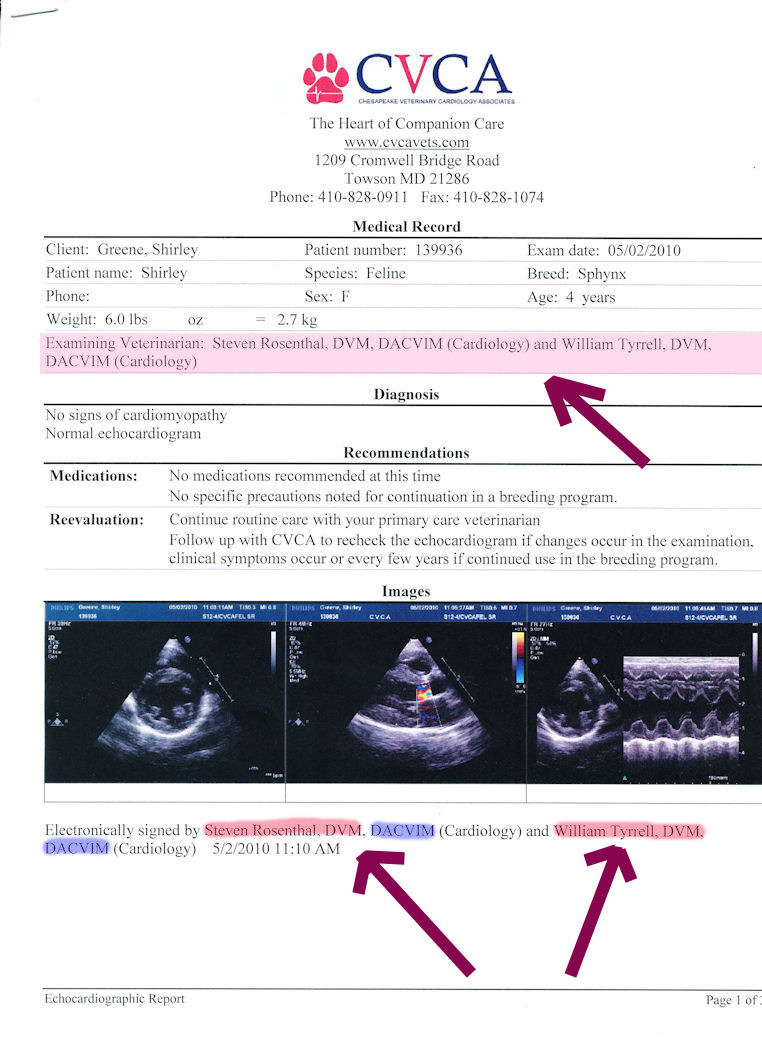
1.) Board Certified cardiologists use "DACVIM" after their name. Click on HCM scan report image below to enlarge to see. Note the highlighted areas with arrows.
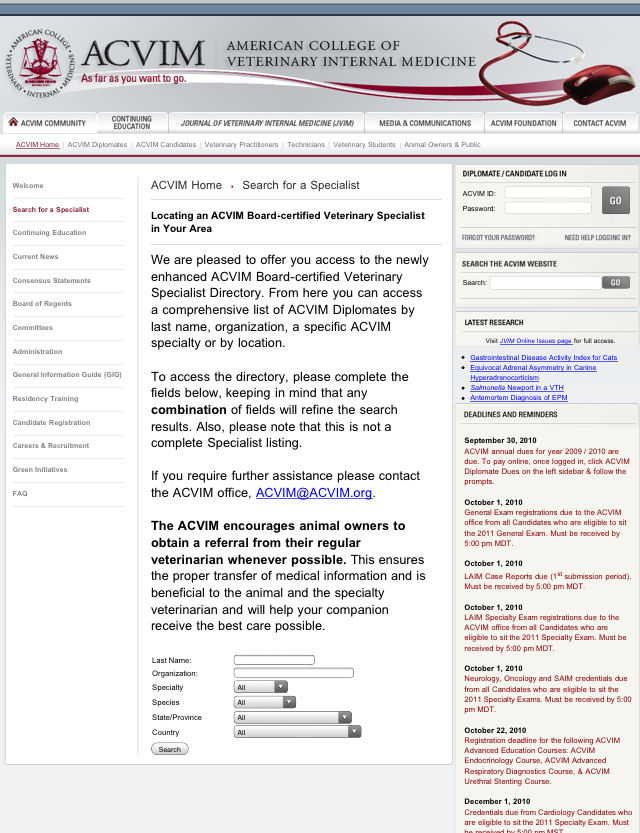
2.) You can check the list yourself on the official ACVIM website
http://www.acvim.org/websites/acvim/index.php?p=3
Just enter the "Cardiology in the specialty area and doctor's name or area and you should see it on this list. Enlarge thumbnail screen shots below for illustration.


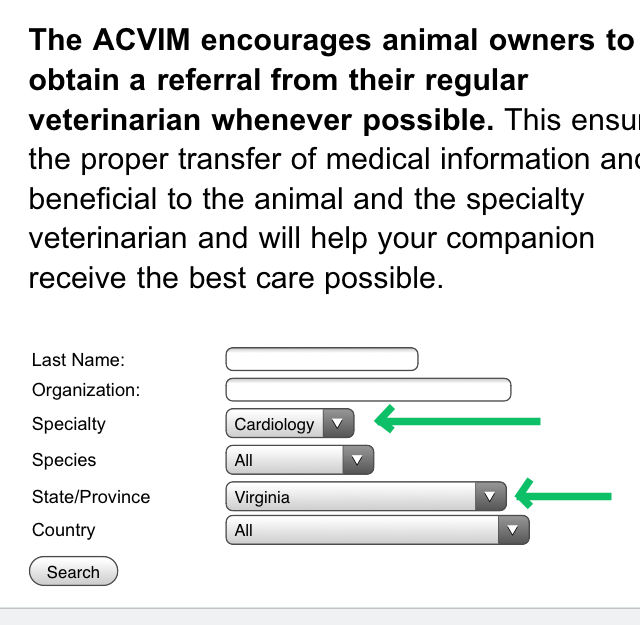
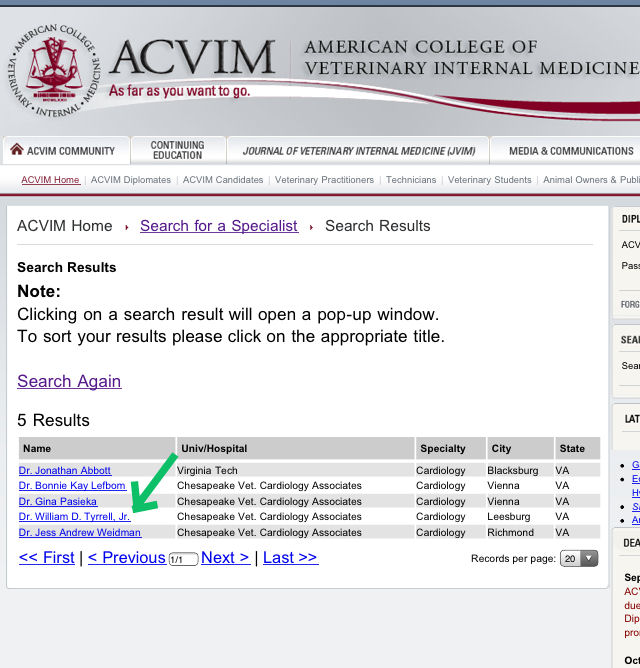
3.) You should be able to contact the cardiologist to verify the fact the cat was scanned by them and scanned "normal".
Lastly, it is important to note that HCM is a complex disease that can appear at any time. Some cats are scanned "normal" throughout their entire life but produce HCM positive kittens. They have the gene but never express it. Yearly scanning is currently the best tool we have to ensure healthy hearts - but it is not foolproof. Unfortunately, even with scanning, any kitten, even from a breeder that scans and does their best, can become HCM positive. You will lower your risk if you use a breeder that does scan and watch the pedigrees.
What to expect at the exam
:The cardiologist will start with a complete physical exam. Heart murmurs can detected with a stethoscope. The cardiologist will also check your pet‘s weight, pulse rate, the color of the mucous membranes, organs, as well as examine him or her for any physical evidence of fluid buildup in the abdomen or extremities.
Usually, at the breeder clinics the diagnostic tests will include:
Cardiac Ultrasound (Echocardiogram): This test allows the visual examination of the interior of the heart, its valves, and its surrounding structures via ultrasonography. It is a sophisticated diagnostic tool.
Doppler Echocardiography: A more advanced form of ultrasonography, this sophisticated technology can enhance the diagnostic information gained from standard two-dimensional ultrasounds. In short, sound waves are bounced off of moving red blood cells in order to determine the movement and force of blood flow within the heart. There are three types of Doppler ultrasound: continuous wave, pulsed wave, and color flow.This test is fairly easy and the cat is placed on a table with a hole in it and then the ultrasound is placed on the heart from below. Sometimes it requires the cat to be restrained, but there is no sedation process.
The Results:
The cardiologist will give you an extensive report that states whether your cat is: normal for breeding, should be held from breeding and brought back for a recheck at 6 months or is not suitable for breeding. Usually an exam done at a clinic is not a full exam and if issues are found you will have to bring the cat back for a full work-up.
Here is an example of a cardiologist report from one of my cats:
http://www.citizenkat.com/hcm_scan.htm
Not always are the results black and white as we wish they would be. Sometimes they need to see the cat once more and see if an anomaly is "normal" for that cat and not a sign of HCM or another heart issue. When diagnosing HCM, a normal heart has a wall thickness around 4.5 mm. Then, there is a grey area between 4.6 and 6.0mm. The cardiologists use their knowledge and other factors (such as size of the cat) as they are looking at the heart to determine the result. If the left ventricle wall thickness if over 6.0 mm the cat will be diagnosed with HCM.
EXAMPLES:
Example 1
: My cat Kayla - picture of health. When I took her to be scanned she was diagnosed by the cardiologists "NOT FOR BREEDING" because she has mitral valve dysplasia. Also taken into consideration that her mother had it more mildly than she did. The cardiologists told me that her offspring could have it worse than Kayla and require medications. If I had not taken her to the cardiologist, I would have never known. Please note, she does not have HCM, but still has a genetic heart defect.Example 2
: My cat Claire- also the picture of health. She was examined the same day in March as Kayla at CVCA. I had already altered her because of a risky pedigree. At the clinic, she was deemed perfectly normal. While disappointed that I had to alter Kayla, I was happy that my two girls were normal and appeared to live normal happy lives. 6 months later on Sept 15, I thought saw Claire sleeping. I went over to touch her and she was cold. I almost did not get a necropsy done - but then I realized I had to know. Sure enough, she had a cardiac arrhythmia and her heart was 1.5 times larger than it should have been for a cat her size.Example 3: A male cat that a friend and I purchased was scanned at 13 months. He appeared to be in excellent health. We were shocked when he positive for HCM. Both his parents had been scanned clear. Thankfully, he was never used in a breeding program to perpetuate this genetic problem. Sadly, in July 2012, just 3.5 years old, Earl passed away in a loving pet home.
Conclusion:
I hope my personal examples show how important it is to take breeding Sphynx to the cardiologist, but it also demonstrates that breeders cannot rely on the scan alone. Responsible breeders must remain cautious in breeding programs and consider the pedigree as well. Those who scan, share the information about their lines with those they work closely with, and are cautious literally help avoid a lot of heartache.
Addendum:
Not only is it important to scan your cats but please be careful of who you work with. At some point in time we have to get our lines, but it is important to make sure you have all information and the person is an open honest person about the lines.
It is important to work with breeders who are ethical and responsible about sharing results and avoid breeders who are not timely and forthcoming in the sharing scan results.
On June 9, 2012 I received a shocking and upsetting email from a public Sphynx forum list that stated the mom of one of my cat's had scanned positive on March 2012. Please note the date, the breeder posted this 3 months after the fact. I received an email March 22, 2012 from that same breeder at the email after the scans of her other cats that scanned normal that were supposedly fine. No mention of my cat's mom being scanned at all that same day. (Why was this omitted?)
It was also very clear about the intent that I was going to breed this cat in my emails to this breeder. This breeder also asked a mutual friend of mine at the airport in late March if I was going to breed the cat. The answer was yes. The cat was already bred by the time this breeder decided to share the information and the breeder, waited until she thought there were kittens on the ground.
The ramifications... not yet known. I have two precious, beautiful babies out of the litter. I hope and pray they will be ok and cannot believe a breeder would be so cruel unethical as to not share the results and intentionally create more HCM risk. This breeder is supposedly involved in HCM research. To this day, I have yet to see the mom's HCM report that is required to be sent within one week of scan by a written contract. Even if it is not in contract, the honorable, moral, ethical thing is to share it with others who have the lines. I am proud to say I have always done this. Good or bad results need to be shared.
The good news is there are breeders who share the news of the heart scans immediately and honestly. My breeding friend, when her one cat scanned positive, she made sure everyone who needed to know (and then some) was told within 2 hours of the scan. Pet buyers were informed. I do not believe the information needs to be public but people who have lines need to know what is going on!
Moral of the story: Be careful who you work with and watch the actions. Not the words. Not the titles (key coordinator, founder, etc) , not the organizations. Ask to see the documents or require them by contract. If being thorough scares someone off, then you did not want to work with them anyway!!!
Frequently Asked Questions:
I heard the Ragdolls and Maine Coons have an HCM DNA test? What about the Sphynx? The Sphynx do not have a DNA test for the HCM gene. Each breed has its own DNA test. Even if there is a day where there is a Sphynx DNA test, cats will still need to be scanned regularly as there are multiple HCM genes.
My Sphynx cat has HCM but both parents are scanned "normal". How can this be? HCM has a variable expression and not all cats who have HCM show symptoms and the age which it shows it can be varied.
As a pet owner, how often should I scan and; Why should I scan? The general recommendation is to scan at 2-3 years old and again at 5-6 years old. These recommendations can vary by new information about pedigree (ie a parent scans positive) or if your cat is showing signs of heart disease (ie develops a murmur, seems tired). Some people are more comfortable scanning more frequently.
One of the most important reasons to scan is to possible prolong its life. Generally a cat that is asymptomatic has a much better chance of living longer with proper medicines. The medicines can help the heart work better and therefore help prevent the left ventricle wall from thickening. A cat that is symptomatic may already have the heart muscle working hard and it may not be able to be treated as easily. It can be scary to scan your Sphynx and it can be a hard diagnosis to take if your cat is positive. However, by scanning your Sphynx - it can extend your kitty's life a great deal.
As a breeder, I realize that most Sphynx will not scan positive the first year they are scanned. Why shouldn't I wait to scan later and save money? The first scan is a baseline exam and this exam will serve as the basis for future scans to determine if there are changes. Also, it does mitigate damage done if a cat has very early onset of HCM because then the cat is altered and not used in a breeding program.
As a breeder or a prospective pet owner, what should I look for? What should I avoid? The breeder should be scanning regularly and know the pedigrees. Everything must have balance, so you still to purchase your kitty from someone who pays attention to overall health, immunity and type. If all aspects of good animal husbandry are not addressed, in my opinion, it is not proper.
Some breeders will say "HCM free 2011". What does that mean? This is a marketing statement used to garner sales. There is no such thing as "HCM free". Only "HCM negative". When that particular breeder does get a positive cat, are they going to put on their website "HCM scanned clear except one?" I doubt it. It is a highly suspect statement. If you breed cats long enough, you will encounter health issues, even if you are trying your hardest to make healthy kitties. Issues do not make a bad breeder, handling them poorly or ignoring them is what differentiates the great from the good from the fair from the bad.
Ok, I looked in the public databases there are and I see the breeder I want to purchase a cat from has an HCM positive cat. Should I purchase from them or avoid that breeder? If the breeder mitigates the damage that makes them a good ethical breeder. Remember, the breeders that care are going to know more about their lines and it might APPEAR they have more HCM when in fact it is just the fact they care and keep in touch and report issues. Basically, you have to look at the whole picture.
I want to contribute to the HCM research, what is the best way? There are several ways you can help. The first is to scan your cat and to encourage others to scan their cats. Then you can submit HCM results to Dr. Meurs (see below). Results are confidential. There are other organizations to donate to, but Winn is the ONLY accredited organization that there is. It is designated as a non-profit and has a fabulous reputation for research, articles and so forth. You have to be careful when dealing with charitable organizations. One such place was selling HCM garb (bracelets, T-shirts, etc) and they did not even scan their own cats! Please check and see if the organization is a 501 C 3 - a registered non-profit organization. you can check on www.guidestar.org.
link to Winn donation page: http://www.winnfelinehealth.org/Pages/MakeDonation.html
My Sphynx was diagnosed with HCM, what should I do? First and foremost, concentrate on getting your kitty the best care. Secondly, you should inform the breeder immediately and send a copy of the report to the breeder (Regardless if you think they care or not... if, in the unfortunate event, they do not care, it is on them and you did all you could to inform). This way the breeder has the information to mitigate any health issues. If, by chance, your regular vet diagnosed it, that is not a proper diagnosis. Your cat needs to see a board certified cardiologist. Only a board certified cardiologist should be diagnosing heart issues.
A responsible ethical breeder will inform all other breeders who have the lines 1-2 generations away within a week of diagnosis. In this manner, each person is given the information to make decisions on their breeding program. These cats not only touch breeder's lives but pet owner's lives.
For more information: http://mysite.verizon.net/jachinitz/hcm/
IS THERE HOPE? Yes! If you are a Sphynx breeder or Sphynx pet owner - you can help... especially if you have the pedigree of your cat! There is a research project headed by Dr. Meurs to find the HCM gene specific to Sphynx. The Maine Coon and Ragdoll breeds have already found a genetic test (although they still must be scanned annually) Most breeders do not keep their cats past the age of 5 and place them into loving pets homes. If you are one of those cats and especially if it is over the age of 8, you can help by scanning your cat and submitting a blood sample. (Information is below)
Please note, that even if there is a Sphynx HCM mutation identified, all Sphynx will still need to be scanned regularly as there are probably multiple mutations.
Dr. Kate Meurs is currently working on a project with Sphynx Breeders and Enthusiasts to find the gene mutation that causes the HCM mutation.
Now, here is the information if you wish to help the breed find HCM. This is a study done by Dr. Meurs.
Sphynx Cat Hypertrophic Cardiomyopathy Study
We are
still very interested in studying Sphynx hypertrophic cardiomyopathy to try
to identify a genetic mutation for this disease. We are currently looking
for more DNA samples from Sphynx cats. At this time we need more samples
from the following:
1. Sphynx cats who DO NOT have hypertrophic cardiomyopathy who are at least 8 years of age
2. Sphynx cats who DO have hypertrophic
cardiomyopathy
Sample collection
Please ask
your veterinarian or a veterinary technician to pull a blood sample into an
EDTA
tube. Most veterinary hospitals have these readily available.
Blood drawn does not need to be mailed back with ice
packs or be shipped overnight. However, if possible please try to send the
sample within a few days by standard mail. Until the blood can be mailed, it
is a good idea to refrigerate it (i.e., if the blood was drawn late Saturday
and cannot be mailed until Monday, it’s a good idea to refrigerate it
between Saturday and Monday).
Questions? Contact Info:
Please return the form on page
2 with your sample and mail to:
NCSU - College of Veterinary Medicine
ATTN: Veterinary Cardiac
Genetics Laboratory
Research Bldg. 460
1060 William Moore Dr.
Raleigh, NC 27607
Sphynx Cat Hypertrophic Cardiomyopathy
Study
Cat Name:
Gender:
Birthdate:
Owner Name:
Complete Address:
Phone Number:
E-mail:
Has your veterinarian ever heard a heart murmur or
gallop?
Had you cat ever been short of breath?
Has your cat ever been diagnosed with heart disease?
Date (if ever) of Last Echocardiogram, please include a
copy of the echocardiogram if possible:
If possible could you please include a Xerox copy of a
pedigree? We are not looking at
certain lines but for certain studies it is important that the cats not be
too closely related
Copyright (©) Citizenkat Sphynx, 2012-2014.
No parts of this website may be reproduced without permission